

Regenerative, orthobiologic care for sacroiliac joint inflammation — the often-missed cause of one-sided low back and buttock pain.
Where your spine meets your pelvis, there is a joint on each side: the sacroiliac joint — the SI joint. It connects the sacrum, the base of your spine, to the ilium, the broad wing of the pelvis.
The SI joint barely moves. Its job is to transfer the entire load of your upper body down into your legs, and to absorb the shock of every step you take. But it is still a true joint — with cartilage and ligaments — and like any joint, it can become inflamed and arthritic.
SI joint pain sits low and to one side, below the beltline. And it is one of the most frequently missed causes of low back pain — because its pattern overlaps so closely with a disc problem or a pinched nerve that it is routinely treated as those instead, while the real source goes unaddressed.
The SI joint is the keystone where two arches of a bridge meet — your spine above, your pelvis and legs below. It carries enormous load while barely moving. When that keystone becomes inflamed, every single step presses on it. And because it sits low and off to the side, the ache is all too easy to blame on the back instead.

SI joint pain has a telling signature — and it behaves differently from a disc or a nerve problem. If several of these fit you, the SI joint is worth a serious look.
SI joint pain sits below the level of the lowest spinal bones — centered over the bony point at the top of one buttock, rather than up in the back.
Many patients place a single fingertip right on the spot. A pain you can pinpoint that precisely is a classic clue that the SI joint is involved.
Standing up from a chair, rolling over in bed, getting out of the car, climbing stairs, or standing on one leg to get dressed can each set it off.
The pain often spreads into the buttock and can reach the groin or the back of the thigh — sometimes mimicking a hip problem or sciatica.
Red flag: numbness, leg weakness, or any bladder or bowel changes point beyond the SI joint — seek prompt evaluation.A long car ride, a long meeting, or too long on your feet on one leg all load the joint and tend to flare it.
Because the patterns overlap, SI joint pain is regularly treated as a disc, a pinched nerve, or a hip. If disc- or nerve-directed care hasn't helped, the SI joint is the question worth asking.
Watch for: low back treatment that simply hasn't worked — it may have been aimed at the wrong joint.The sacroiliac joint is estimated to be the source of 15–30% of chronic low back pain — roughly one in four or five cases. Yet it remains one of the most under-recognized, because the diagnosis is rarely handed to you by a scan.
An MRI of the lumbar spine can look nearly unremarkable while the SI joint is the genuine problem. The diagnosis leans on the exam — exactly where the pain sits, how it behaves, and a set of specific provocation maneuvers that load the joint — far more than on imaging alone.
That is precisely the kind of careful, hands-on assessment the first consult is built around: matching where you hurt to how the joint actually behaves, instead of treating the loudest finding on a report.
"When low back treatment hasn't worked, the SI joint is the question worth asking."
— Orthobiogen care philosophy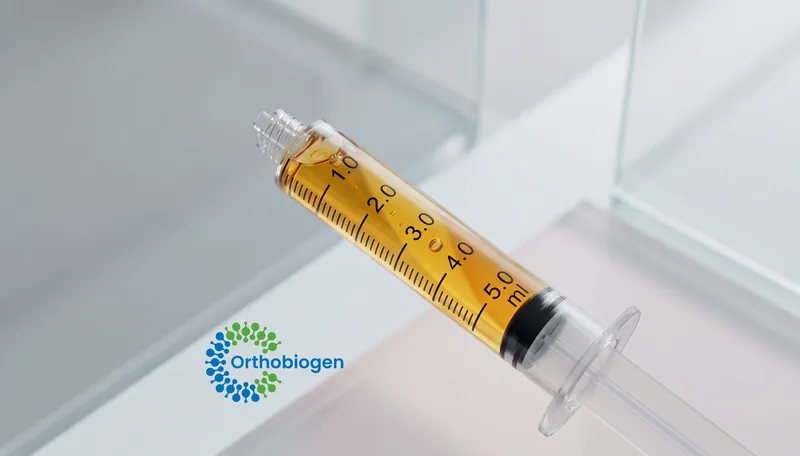
It has cartilage, a capsule, and a dense network of stabilizing ligaments. When it becomes inflamed and arthritic, it can be treated as a joint — not simply silenced.
A small sample of your own blood is concentrated for its platelets and growth factors. Placed into and around the SI joint, it is used to calm inflammation and support a healthier joint environment.
The SI joint is deep and narrowly shaped — reaching it accurately takes live image guidance, not a landmark-based guess. Precise placement is what makes the treatment count.
SI joint pain often involves the strong ligaments that stabilize the joint, and the muscles that have been guarding around it. Care addresses the whole structure, not one point.
For SI joint pain, most patients are offered steroid injections or, eventually, surgery to fuse the joint with implants. Here is how an orthobiologic approach differs.
| SI Steroid Injections | SI Joint Fusion Surgery | Orthobiogen |
|---|---|---|
| ✗ Suppresses joint inflammation with corticosteroid — temporarily | ✗ Bolts the joint with implants so it can no longer move | ✓ Calms and supports the SI joint with your own biologics |
| ✗ Corticosteroid — repeated use can weaken nearby tissue | ✗ Titanium implants placed permanently across the joint | ✓ Platelets or marrow drawn from your own body |
| ✗ Does nothing lasting to the joint itself | ✗ Eliminates the joint rather than treating it | ✓ Aims to support a healthier joint environment |
| ✗ Limited — steroid doses are capped per year | ✗ Permanent and irreversible once the joint is fused | ✓ Repeatable, with nothing implanted or fused |
| ✗ Often a brief visit with little hands-on assessment | ✗ Operating room, anesthesia, and a recovery period | ✓ A careful, exam-based assessment walked through with you |
| ✗ "Try a shot and see," with little candidacy screening | ✗ A major, final step for a joint that may respond to less | ✓ An honest answer on whether you are a candidate, first |
Not necessarily — fusion is a major, final step for a joint that may respond to less. SI joint fusion bolts the joint with titanium implants so it can no longer move, eliminating the joint rather than treating it. The SI joint is a true joint with cartilage, a capsule, and ligaments, and it can be treated as a joint instead of being fused.
An MRI of the lumbar spine can look nearly unremarkable while the SI joint is the genuine problem. The SI joint is estimated to be the source of 15 to 30% of chronic low back pain, yet it remains one of the most under-recognized causes — the diagnosis leans on the exam and specific provocation maneuvers far more than on imaging alone.
An SI steroid injection suppresses joint inflammation with corticosteroid only temporarily and does nothing lasting to the joint itself, and steroid doses are capped per year. Regenerative care places platelets from your own blood into and around the SI joint to calm inflammation and support a healthier joint environment, and it is repeatable, with nothing implanted or fused.
Generally no. Regenerative orthobiologic treatment is typically not covered by insurance. If you move forward, the costs are discussed openly and in full before anything is scheduled — no surprises.
Start with a free 15-minute introductory telemedical consult — a no-pressure conversation about your history and any imaging, with a candid read on whether regenerative care is a reasonable fit. The fastest way to begin is the secure online intake form, and Dr. Booth's team follows up with you directly.
Part of why the SI joint is so often missed: its pain rarely stays put. Studies mapping where patients feel SI joint pain show it spreading well beyond the joint itself — into the lower back, the groin, even higher up — territory usually blamed on a disc.
Source: SI joint pain referral-pattern data summarized in Szadek KM, et al. Sacroiliac joint pain. Pain Practice. 2024. Shares describe where patients with confirmed SI joint pain report feeling it; categories overlap.
The first step is a complimentary, 15-minute introductory telemedical consult. It is a no-pressure conversation to hear your story, look at what you have already tried, and give you a candid sense of whether regenerative care is a reasonable fit for your SI joint pain.
Please note: complimentary telemedical consults have limited availability because of Dr. Booth's clinical schedule. If a slot is not immediately open, we appreciate your patience — or you are welcome to request a standard in-person appointment instead, which can often be arranged sooner.
One more thing we believe in saying plainly: regenerative orthobiologic treatment is generally not covered by insurance. If you move forward, costs are discussed openly and in full before anything is scheduled — no surprises.
The fastest way to begin is our secure online intake form. You share your background once, and our team reaches out to you directly.
Lower back pain rarely has a single cause — and these conditions often overlap and feed one another. Explore the others we treat with regenerative, orthobiologic care.
Deterioration of the cushioning discs between the back bones.
Learn more →Lower back pain that radiates down the leg.
Learn more →Arthritis of the small facet joints in the low back.
Learn more →Muscle knots and spasms, often driven by joint inflammation.
Learn more →
Call to schedule, or ask about a free 15-minute introductory telemedical consult. Consult slots are limited by Dr. Booth's schedule — if none is open, an in-person appointment can often be arranged sooner.