

Regenerative, orthobiologic care for meniscus tears — calming and supporting the knee's cushion cartilage instead of trimming it away.
Each knee has two menisci — a pair of tough, C-shaped pads of cartilage that sit between the thigh bone and the shin bone. They spread load across the joint, absorb shock with every step, and help keep the knee stable.
A meniscus tear is a split or fray in one of those pads. Tears come in two broad kinds: a sudden traumatic tear, often from a twist or pivot, and a degenerative tear — the slow fraying that comes with age and is closely tied to arthritis.
Which kind you have matters enormously, because they behave — and respond to treatment — very differently. A degenerative tear, the most common kind after 40, is usually one part of the wider wear in the joint, not a separate emergency that demands the operating room.
Think of the meniscus like the rubber gasket that cushions two surfaces in a machine. Over years it stiffens and frays at the edges. You would not rip out a worn gasket and run the machine with a gap where it used to be — you would protect it and ease the load on it. The cushion in your knee deserves the same care.

A torn meniscus has a recognizable signature. If several of these fit you, the meniscus is likely part of the picture.
A tender, specific spot right along the seam where the thigh and shin bones meet — most often on the inner side of the knee.
The torn flap of cartilage can get caught as the knee bends and straightens, producing a click or a snag.
The knee puffs up after activity, settles down with rest, then flares again the next time you push it.
Movements that pinch the meniscus between the bones — turning to reach something, squatting down, deep bending — tend to set it off.
The knee can feel unreliable on stairs or uneven ground, as if it could buckle without warning.
A knee stuck partway bent that will not fully straighten — no matter how you try — can mean a torn fragment is wedged in the joint.
Watch for: a genuinely locked knee needs prompt, in-person evaluation.An MRI is very good at finding meniscus tears — sometimes too good. After about age 40, degenerative meniscus tears are remarkably common, including in knees that feel completely fine.
In a large study of adults aged 50 to 90 who were not selected for knee pain, meniscal tears showed up on MRI in 19% to 56% of knees, depending on age and sex — and 61% of the people who had a tear had felt no knee pain, aching, or stiffness at all in the previous month.
So finding a tear on your scan does not, by itself, prove it is the source of your pain. Very often it is simply part of the knee's normal aging.
This matters for treatment. In a sham-controlled trial, surgery to trim a degenerative meniscus tear was no better than a placebo (sham) operation — and at five years, the trimmed knees showed slightly more arthritis. Removing meniscus tissue takes away cushioning the joint depends on for the long run.
"A tear on the scan is a finding — not automatically the diagnosis, and not automatically a surgery."
— Orthobiogen care philosophy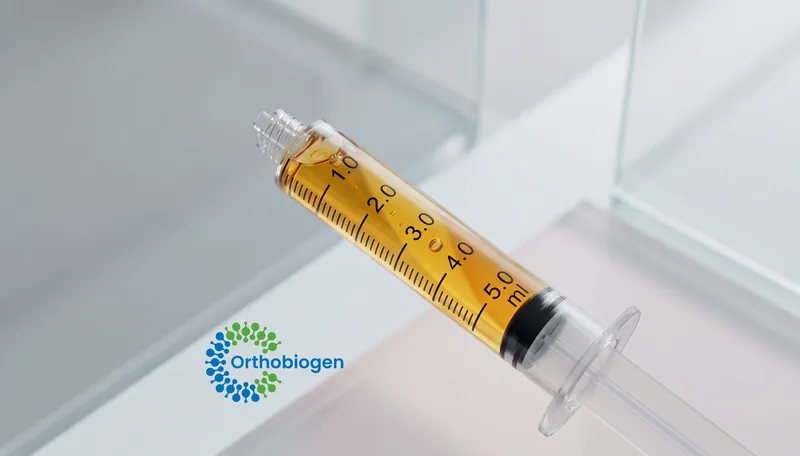
Its outer rim has a blood supply and can respond to healing signals; the inner portion has almost none. Where a tear sits within the meniscus shapes what is realistic — and is part of what Dr. Booth assesses.
A small sample of your own blood is concentrated for its platelets and growth factors, then placed precisely in and around the joint to calm inflammation and support a healthier healing environment.
When a case calls for more, a small sample of your own bone marrow provides a richer mix of regenerative cells. Whether PRP or marrow fits best is a clinical decision Dr. Booth makes with you.
Every piece of meniscus you keep is cushioning that protects the joint surfaces from arthritis down the road. The goal is to support the cartilage you have — not to trim it away.
Most patients with a meniscus tear are offered arthroscopic surgery to trim it, or a cortisone shot to quiet things down. Here is how an orthobiologic approach differs.
| Arthroscopic Meniscus Surgery | Cortisone Injection | Orthobiogen |
|---|---|---|
| ✗ Trims away the torn meniscus tissue | ✗ Quiets inflammation for a few months | ✓ Calms the joint and supports the meniscus with your own biologics |
| ✗ Removes cushioning — permanently | ✗ Does nothing for the tear itself | ✓ Aims to protect the meniscus you still have |
| ✗ No better than sham surgery for degenerative tears in controlled trials | ✗ Short-lived relief, capped doses per year | ✓ Platelets or marrow drawn from your own body |
| ✗ Meniscus removal raises the long-term risk of knee arthritis | ✗ No protective effect on the joint | ✓ Aims to preserve cushioning the joint depends on |
| ✗ Operating room, anesthesia, and a rehab period | ✗ Often a brief visit with little imaging review | ✓ Outpatient, with your imaging walked through with you |
| ✗ Often driven by the scan alone — "the MRI shows a tear" | ✗ "Try a shot and see," with little candidacy screening | ✓ An honest answer on whether you are a candidate, first |
No. A meniscus tear is not an automatic surgery. A degenerative tear, the most common kind after 40, is usually one part of the wider wear in the joint, not a separate emergency that demands the operating room — though a knee that is truly locked, stuck partway bent and unable to fully straighten, does need prompt in-person evaluation.
Not by itself. After about age 40, degenerative meniscus tears are remarkably common, including in knees that feel completely fine. In a large study of adults aged 50 to 90 who were not selected for knee pain, meniscal tears showed up on MRI in 19% to 56% of knees, and 61% of the people who had a tear had felt no knee pain, aching, or stiffness in the previous month. A tear on the scan is a finding, not automatically the diagnosis.
For a degenerative tear, surgery to trim it was no better than a placebo, or sham, operation in a controlled trial — and at five years the trimmed knees showed slightly more arthritis. Trimming the meniscus removes cushioning the joint depends on for the long run. Regenerative care instead uses your own platelets or marrow to calm the joint and support the meniscus you still have.
Generally no. Regenerative orthobiologic treatment is typically not covered by insurance. If you move forward, the costs are discussed openly and in full before anything is scheduled — no surprises.
Start with a free 15-minute introductory telemedical consult — a no-pressure conversation about your history and any imaging you already have, with a candid read on whether regenerative care is a reasonable fit for your knee. The fastest way to begin is the secure online intake form, and Dr. Booth's team follows up with you directly.
In a study of adults aged 50 to 90 drawn from the general population — not a knee-pain clinic — meniscal tears on MRI were almost as common in knees without symptoms as in knees with them.
Source: Englund M, et al. Incidental Meniscal Findings on Knee MRI in Middle-Aged and Elderly Persons. N Engl J Med. 2008;359(11):1108–1115. "Symptoms" = knee pain, aching, or stiffness on most days.
The first step is a complimentary, 15-minute introductory telemedical consult. It is a no-pressure conversation to hear your story, look at what you have already tried, and give you a candid sense of whether regenerative care is a reasonable fit for your knee.
Please note: complimentary telemedical consults have limited availability because of Dr. Booth's clinical schedule. If a slot is not immediately open, we appreciate your patience — or you are welcome to request a standard in-person appointment instead, which can often be arranged sooner.
One more thing we believe in saying plainly: regenerative orthobiologic treatment is generally not covered by insurance. If you move forward, costs are discussed openly and in full before anything is scheduled — no surprises.
The fastest way to begin is our secure online intake form. You share your background once, and our team reaches out to you directly.
Knee pain rarely has a single cause — and these conditions often overlap and feed one another. Explore the others we treat with regenerative, orthobiologic care.
Wear-and-tear cartilage loss in the knee joint.
Learn more →Kneecap pain and softening of the cartilage behind it.
Learn more →Knee tendon pain, often from overload and overuse.
Learn more →ACL/PCL and MCL/LCL sprains and joint instability.
Learn more →
Call to schedule, or ask about a free 15-minute introductory telemedical consult. Consult slots are limited by Dr. Booth's schedule — if none is open, an in-person appointment can often be arranged sooner.