

Regenerative, orthobiologic care for sciatica — calming the irritated nerve at its source instead of masking it with repeated steroid shots.
Sciatica is less a diagnosis than a description: pain that travels along the sciatic nerve — the largest nerve in the body — running from your lower back, through the buttock, and down the leg.
Here is the key point. The pain you feel in your leg almost always begins in your back. Where a nerve root exits the spine, something is irritating it — most often a bulging or herniated disc, sometimes a narrowed space around the nerve.
And the disc irritates that nerve in two ways: it can press on it, and it can leak inflammatory chemicals onto it. That second part matters — it means sciatica is as much an inflammation problem as a pressure problem, which is exactly why calming that inflammation can bring the leg pain down.
Think of the nerve like the wiring that runs from a circuit breaker to a light across the room. The fault is at the breaker — in your back — but you notice it at the light: your leg. Chase the flicker at the bulb and you will never fix it. The problem, and the fix, are at the source.
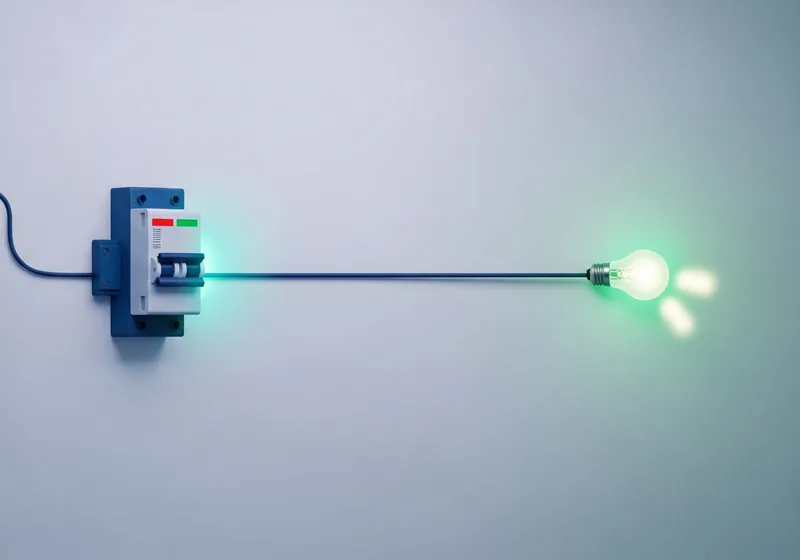
Sciatica has a distinctive signature — it usually feels different from an ordinary sore back. If several of these fit you, the nerve is likely involved.
It runs from the low back or buttock down the back or side of the thigh — and often past the knee into the calf or foot. The leg pain is frequently worse than the back pain itself.
Not the dull ache of a strained back. Sciatica often feels like a hot wire, a jolt of electricity, or a deep burn down the leg.
Patches of the leg or foot may tingle, feel numb, or feel dull to the touch — a sign the nerve's signal is being disrupted.
Anything that raises pressure inside the disc or tugs on the nerve — a long drive, leaning forward, even a sneeze — can spike the pain down the leg.
Classic sciatica follows one nerve down one leg. It rarely strikes both legs equally at the same time.
Red flag: pain down both legs at once, or numbness in the saddle area, needs prompt evaluation.A foot that drags or won't lift, leg weakness that is getting worse, numbness in the groin or inner thighs, or any change in bladder or bowel control.
Watch for: these need same-day, in-person evaluation — call us or seek urgent care.Most sciatica improves. An estimated 80–90% of cases get better without surgery, and the body is remarkably good at clearing the cause: across pooled studies, roughly two-thirds of herniated discs shrink and reabsorb on their own — and the more dramatic the herniation, the more likely it is to resolve.
But "most" is not "all." Around 30% of people still have troublesome symptoms a year later. When sciatica digs in, stops improving, and starts running your days, that is the signal to look harder — not to wait indefinitely hoping, and not to jump straight to surgery.
That middle ground — past "give it time," short of the operating room — is exactly where regenerative care fits. The first step is simply an honest assessment of where your sciatica actually sits.
"The leg is where you feel it. The back is where we treat it."
— Orthobiogen care philosophy
A herniated disc does not only push on the nerve root — it bathes it in inflammatory chemicals. Easing that chemical irritation is often what actually brings the leg pain down.
A small sample of your own blood is concentrated for its platelets and growth factors. Placed precisely around the irritated nerve root, it is used to support a calmer healing environment — rather than the blunt, dose-capped suppression of a steroid.
The target is small and specific — the nerve root and the disc behind it. Image guidance puts the biologic exactly where the problem is, not in the general neighborhood.
The disc that started it, and the joints and muscles now bracing and guarding around it, are all part of the picture. Care addresses the segment as a unit.
Most patients with stubborn sciatica are offered two paths: repeated epidural steroid injections, or surgery to remove the disc fragment. Here is how an orthobiologic approach differs.
| Epidural Steroid Injections | Microdiscectomy Surgery | Orthobiogen |
|---|---|---|
| ✗ Suppresses inflammation with corticosteroid — temporarily | ✗ Cuts the herniated fragment away from the nerve | ✓ Calms the irritated nerve root with your own biologics |
| ✗ Corticosteroid — repeated use can weaken nearby tissue | ✗ Removes disc tissue — it does not grow back | ✓ Platelets or marrow drawn from your own body |
| ✗ Limited — steroid doses are capped per year | ✗ Irreversible; the disc stays degenerated | ✓ Repeatable, with nothing removed or left behind |
| ✗ Often a brief visit with little imaging review | ✗ Operating room, anesthesia, and a recovery period | ✓ Outpatient under local — your MRI walked through with you |
| ✗ "Try a shot and see," with little candidacy screening | ✗ A major step for a problem that often resolves on its own | ✓ An honest answer on whether you are a candidate, first |
Often not. An estimated 80 to 90% of cases get better without surgery, and across pooled studies roughly two-thirds of herniated discs shrink and reabsorb on their own. But around 30% of people still have troublesome symptoms a year later — and when sciatica digs in and stops improving, that is the signal to look harder, not to jump straight to surgery.
The pain you feel in your leg almost always begins in your back, where a nerve root exits the spine and something — most often a bulging or herniated disc — is irritating it. The leg is where you feel it, but the back is where it is treated.
An epidural steroid injection suppresses inflammation with corticosteroid only temporarily, and steroid doses are capped per year. Regenerative care places platelets from your own blood precisely around the irritated nerve root to support a calmer healing environment — rather than the blunt, dose-capped suppression of a steroid — and it is repeatable, with nothing removed or left behind.
Generally no. Regenerative orthobiologic treatment is typically not covered by insurance. If you move forward, the costs are discussed openly and in full before anything is scheduled — no surprises.
Start with a free 15-minute introductory telemedical consult — a no-pressure conversation about your history and any imaging, with a candid read on whether regenerative care is a reasonable fit. The fastest way to begin is the secure online intake form, and Dr. Booth's team follows up with you directly.
It surprises most patients: the body frequently clears a disc herniation without any procedure at all. In a meta-analysis of more than 2,200 patients managed conservatively, the chance of spontaneous resorption rose with how dramatic the herniation was — most of it happening within six months.
Source: Zhong M, et al. Incidence of Spontaneous Resorption of Lumbar Disc Herniation: A Meta-Analysis. Pain Physician. 2017;20(1):E45–E52. Pooled data from patients treated conservatively.
The first step is a complimentary, 15-minute introductory telemedical consult. It is a no-pressure conversation to hear your story, look at what you have already tried, and give you a candid sense of whether regenerative care is a reasonable fit for your sciatica.
Please note: complimentary telemedical consults have limited availability because of Dr. Booth's clinical schedule. If a slot is not immediately open, we appreciate your patience — or you are welcome to request a standard in-person appointment instead, which can often be arranged sooner.
One more thing we believe in saying plainly: regenerative orthobiologic treatment is generally not covered by insurance. If you move forward, costs are discussed openly and in full before anything is scheduled — no surprises.
The fastest way to begin is our secure online intake form. You share your background once, and our team reaches out to you directly.
Lower back pain rarely has a single cause — and these conditions often overlap and feed one another. Explore the others we treat with regenerative, orthobiologic care.
Deterioration of the cushioning discs between the back bones.
Learn more →Arthritis of the small facet joints in the low back.
Learn more →Arthritis below the beltline, where the spine meets the pelvis.
Learn more →Muscle knots and spasms, often driven by joint inflammation.
Learn more →
Call to schedule, or ask about a free 15-minute introductory telemedical consult. Consult slots are limited by Dr. Booth's schedule — if none is open, an in-person appointment can often be arranged sooner.