

Regenerative, orthobiologic care for patellar and quadriceps tendinopathy — for knee tendon pain that rest and anti-inflammatories haven't fixed.
Two strong tendons anchor the front of your knee. The quadriceps tendon connects the big thigh muscle to the top of the kneecap; the patellar tendon runs from the bottom of the kneecap down to the shin bone. Together they transmit the force that straightens your knee — every step, every stair, every jump.
Tendinopathy is what happens when the load placed on one of those tendons outpaces its ability to repair. The tendon's collagen — normally aligned like a tight, orderly rope — becomes disorganized and weaker in one section. Patellar tendinopathy is common enough in jumping sports to have earned a nickname: jumper's knee.
You will often hear this called "tendinitis." That word is misleading — and the difference genuinely changes what helps. More on that below.
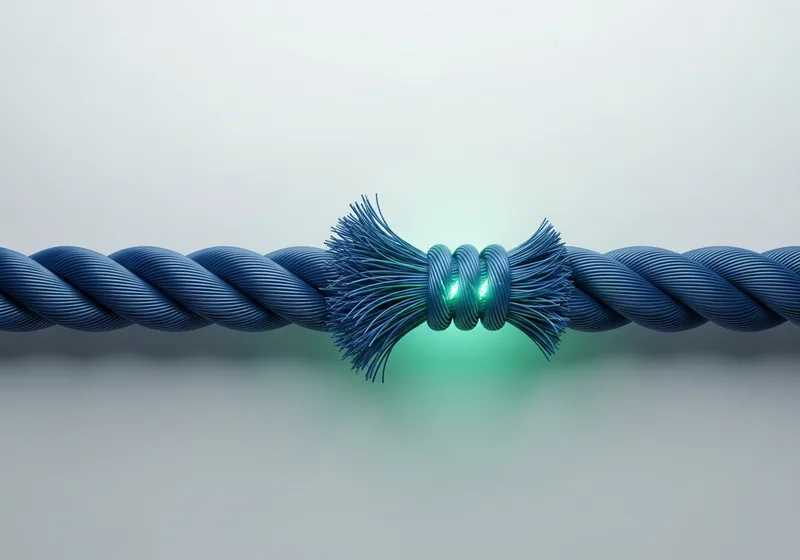
Think of a tendon as a rope made of countless fibers all pulling in the same direction. Healthy, every fiber shares the load. Overloaded faster than it can repair, fibers fray and tangle — the rope still works, but the frayed section carries less and complains more. You do not fix a frayed rope by resting it in a drawer. You rebuild the fibers.
Tendon pain has a distinctive signature — and it behaves differently from a joint or meniscus problem. If several of these fit you, a tendon is likely involved.
Just below the kneecap (the patellar tendon) or just above it (the quad tendon) — often a spot you can pinpoint with one finger.
Jumping, running, stairs, squatting, or pushing up out of a deep chair — anything that asks the tendon to work hard.
Stiff and sore at the start of activity, easing as you warm up — then aching worse afterward and stiff again the next morning.
A nagging soreness in the tendon when you stand up after a long drive, a meeting, or a movie.
The tendon can feel distinctly tender — and sometimes thickened or "lumpy" — when you press on it.
A sudden pop with sharp pain, trouble straightening the knee or a kneecap that sits unusually high or low, after a forceful effort.
Watch for: this needs prompt, in-person evaluation rather than waiting it out.For decades this was called tendinitis — the "-itis" ending meaning inflammation. Research has changed that picture. When a tendon has been painful for weeks or months, there is surprisingly little inflammation in it.
The real problem is degeneration: the tendon's collagen has become disorganized, and the tissue has not kept pace with repairing the load placed on it. The accurate terms are tendinopathy, or tendinosis.
This is not word-splitting — it changes what actually helps. If the problem were simply inflammation, rest and anti-inflammatory medication would settle it. For a degenerated tendon, they often disappoint. It also explains a real caution: a steroid injected into a tendon can quiet pain briefly, but it can weaken the tendon and has been linked to a higher risk of rupture.
What a degenerated tendon actually needs is a reason and a way to rebuild — the right kind of loading, and support for the repair process itself. That is the approach this page is built around.
"It was never really 'tendinitis.' Treating it as an inflammation problem is why it so often lingers."
— Orthobiogen care philosophy
The tendon's collagen has become disorganized from load that outpaced repair. That is why "just rest it" and anti-inflammatories so often disappoint — they treat a problem that is not really there.
A progressive tendon-loading program — the controlled, graded strengthening a good therapist guides — is the evidence-based first-line treatment and helps many people. Regenerative care complements that work; it does not replace it.
A small sample of your own blood is concentrated for its platelets and growth factors, then placed precisely into the degenerated portion of the tendon to support a healthier repair environment.
The tendon itself, the way it is being loaded, and the strength around it are addressed as one plan — because a tendon only stays better if the load it carries is rebuilt to match.
Most patients with knee tendon pain are told to rest and take anti-inflammatories, or are offered a cortisone shot. Here is how an orthobiologic approach differs.
| Cortisone Injections | Rest & Anti-Inflammatories | Orthobiogen |
|---|---|---|
| ✗ Targets inflammation that is largely not the problem | ✗ Waits the pain out and mutes it with medication | ✓ Supports the tendon's actual repair with your own biologics |
| ✗ Does nothing for the disorganized tendon collagen | ✗ A deconditioned tendon often flares again on return | ✓ Aims to support healthier, better-organized tendon tissue |
| ✗ Steroid in a tendon can weaken it and raise rupture risk | ✗ NSAIDs ease pain but do not rebuild the tendon | ✓ Platelets or marrow drawn from your own body |
| ✗ Short-lived; the tendinopathy itself persists | ✗ Symptoms commonly return as soon as activity does | ✓ Aimed at the cause, paired with a structured loading program |
| ✗ Often a brief visit with little imaging review | ✗ Months of avoiding the activities you value | ✓ Outpatient, with your imaging walked through with you |
| ✗ "Try a shot and see," with little candidacy screening | ✗ No real plan beyond waiting | ✓ An honest answer on whether you are a candidate, first |
For most people, no. A progressive tendon-loading program — the controlled, graded strengthening a good therapist guides — is the evidence-based first-line treatment and helps many people. Regenerative care complements that work rather than replacing it. A sudden pop with sharp pain and trouble straightening the knee, however, can mean a tendon rupture and needs prompt in-person evaluation.
It matters a great deal. The “-itis” ending means inflammation, but when a tendon has been painful for weeks or months there is surprisingly little inflammation in it. The real problem is degeneration — the tendon's collagen has become disorganized — which is why the accurate terms are tendinopathy or tendinosis, and why treating it as inflammation is why it so often lingers.
Because the problem is degeneration rather than inflammation, rest and anti-inflammatory medication often disappoint, and a deconditioned tendon tends to flare again as soon as activity returns. A steroid injected into a tendon can quiet pain briefly but can weaken the tendon and has been linked to a higher risk of rupture. A degenerated tendon needs a way to rebuild — the right loading and support for the repair itself.
Generally no. Regenerative orthobiologic treatment is typically not covered by insurance. If you move forward, the costs are discussed openly and in full before anything is scheduled — no surprises.
Start with a free 15-minute introductory telemedical consult — a no-pressure conversation about your history and any imaging you already have, with a candid read on whether regenerative care is a reasonable fit for your knee. The fastest way to begin is the secure online intake form, and Dr. Booth's team follows up with you directly.
Patellar tendinopathy earned the name "jumper's knee" for a reason. A study of elite athletes across nine sports found it concentrated heavily in the jumping sports, where the tendon is loaded again and again.
Source: Lian ØB, Engebretsen L, Bahr R. Prevalence of Jumper's Knee Among Elite Athletes From Different Sports: A Cross-sectional Study. Am J Sports Med. 2005;33(4):561–567.
The first step is a complimentary, 15-minute introductory telemedical consult. It is a no-pressure conversation to hear your story, look at what you have already tried, and give you a candid sense of whether regenerative care is a reasonable fit for your knee.
Please note: complimentary telemedical consults have limited availability because of Dr. Booth's clinical schedule. If a slot is not immediately open, we appreciate your patience — or you are welcome to request a standard in-person appointment instead, which can often be arranged sooner.
One more thing we believe in saying plainly: regenerative orthobiologic treatment is generally not covered by insurance. If you move forward, costs are discussed openly and in full before anything is scheduled — no surprises.
The fastest way to begin is our secure online intake form. You share your background once, and our team reaches out to you directly.
Knee pain rarely has a single cause — and these conditions often overlap and feed one another. Explore the others we treat with regenerative, orthobiologic care.
Wear-and-tear cartilage loss in the knee joint.
Learn more →Damage to the knee's C-shaped cushion cartilage.
Learn more →Kneecap pain and softening of the cartilage behind it.
Learn more →ACL/PCL and MCL/LCL sprains and joint instability.
Learn more →
Call to schedule, or ask about a free 15-minute introductory telemedical consult. Consult slots are limited by Dr. Booth's schedule — if none is open, an in-person appointment can often be arranged sooner.